Jeong-Ah Zhang
Biography
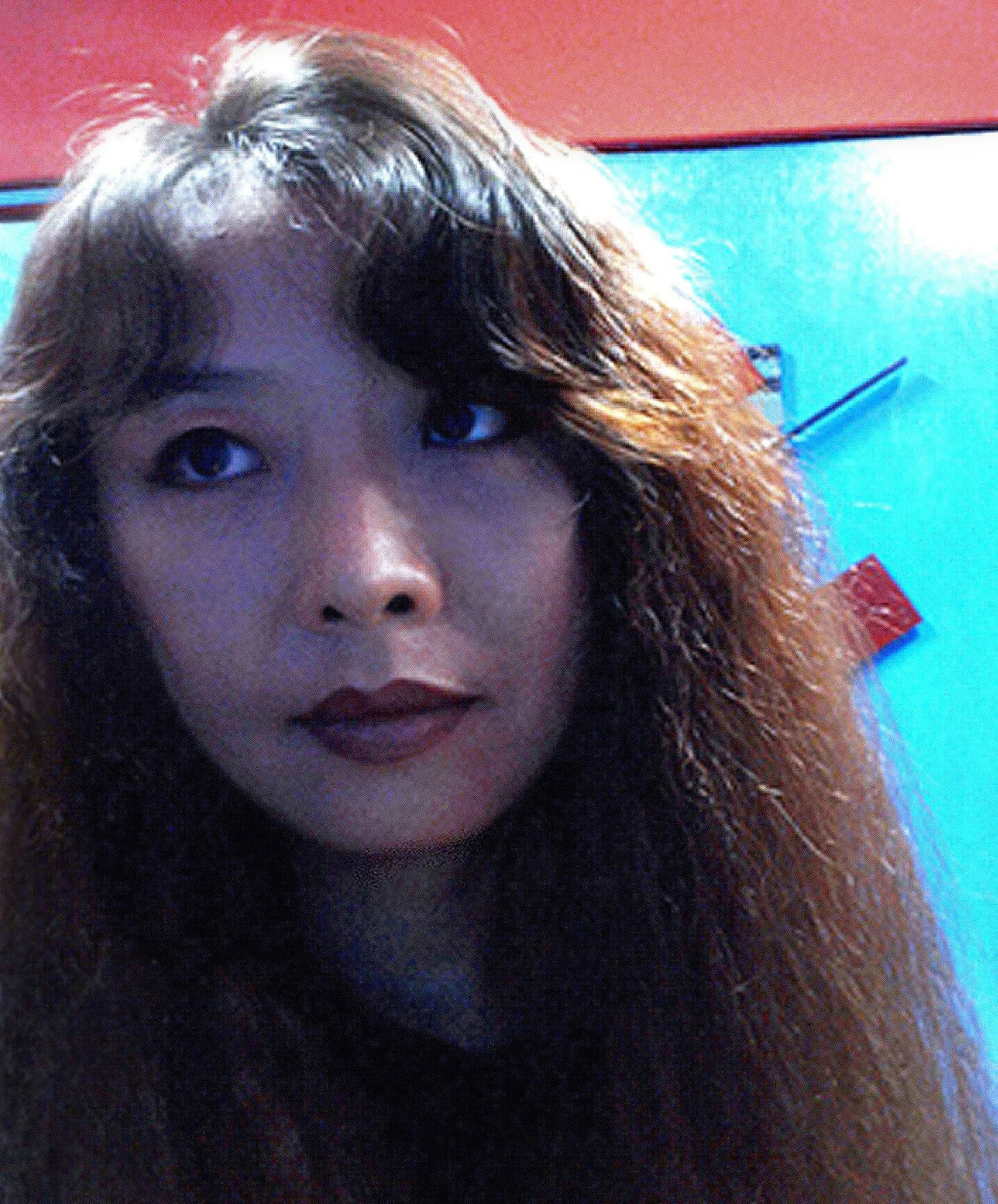
Born and based in Seoul, South Korea, on July 3, 1966, Jeong-Ah Zhang is an internationally active contemporary artist who specializes in painting and has achieved significant international recognition.
In the dynamic world of contemporary art, Jeong-Ah Zhang emerges as a profound statement on existential reflection and metaphysical dialogue, capturing the spirit of a generation that seeks to transcend traditional artistic boundaries. Jeong-Ah Zhang's ability to convey complex, abstract ideas through tangible imagery sets her apart as a visionary in contemporary art. Her art is not just singular; it is timeless. Jeong-Ah Zhang’s contribution to contemporary art is not a trend. It is a legacy.
Jeong-Ah Zhang majored in fine arts at Ewha Womans University in Seoul. During her time there, she also won first prize in the play literature category of the university literature award for three consecutive years, separate from her field of study. After graduating from university, she worked as an assistant director for a prominent theater company in Seoul for several years, during which time she seriously considered becoming a monk, driven by profound questions about life and death, creation and extinction. Afterwards, she traveled to 30 countries on adventurous solo backpacking trips in her late 20s and early 30s, while her mindfulness routine fostered a harmonious balance of mental focus, creativity, and originality that she later drew upon in creating her artworks.
Echoes of her own spiritual journey and meditation, an extension of the transcendental experiences of magical realism at the age of eight that foreshadowed her identity, became a crucial trigger for her fundamental insight into a multidimensional world where the boundaries between reality and the virtual disappeared, making the meaning of time and space dissolve. Building on this foundation, she began her artistic career in earnest in 1999 at the age of 33, debuting in the art world that same year by winning an award at Korea's biggest art competition. Since then, she has dedicated herself to artistic activities for the past 26 years.
Jeong-Ah Zhang has held five solo exhibitions in Korea, Canada, and the United States, and her works have been invited to over 120 group exhibitions and art fairs in the United States, Canada, Korea, France, Italy, Spain, the Netherlands, Germany, the United Kingdom, Switzerland, Japan, and the United Arab Emirates. She has also won 56 prestigious international awards in many countries around the world, including 15 art competitions in Korea. Her talent has garnered attention in more than 100 international art publications and magazines, and she was honored as the cover artist for the "2026 Collectors Art Prize - Art Legends Of Our Time" by Contemporary Art Curator Magazine and the "2024 Global Art Virtuoso: Elite Artistic Career Achievement Award" by Contemporary Art Collectors.
Artist Statement
My life and art are based on my own philosophical thoughts and experiences. I am interested in the philosophy of immanence and transcendence in relation to all beings. This means that I try to focus on the essence of life by establishing core values and, at the same time, sublimate them into my works.
I think there is a series of underlying visual realities that have come into play in the modern world. In general, the objects of awareness are split between the intelligible world and the visible world. There may be many answers, but I think what is important is the reality of the invisible world over the visible. This is a rediscovery of the stream of consciousness based on ancient Oriental philosophy, and the idea of recognizing the truth is linked to being beyond the material world with all its visual appeal.
I think it is important to first have a deeper and broader perspective on emptiness. Emptiness has been a word with many meanings, aspects, and feelings from different viewpoints in various cultures. Cambridge vocabulary uses “sad feeling,” “not sincere,” and “a state with no emotion or purpose” for emptiness, while in Buddhism it is called “the true nature of things and events.” While a Western view of emptiness often seems to be negative, in some Eastern philosophies, it represents a state of stillness and placidity that allows one to see through illusion, representing the “mirror of the universe” and the “pure mind.” Lao Tzu, in Tao Te Ching, artistically quotes: “We mold clay into a pot, but it is the emptiness inside that makes the vessel useful.”
I think the important thing is not how to look at it, but what to look at. At the same time, it is also a reminder that the material world is not all there is. I look at the relationship between humans, Mother Nature, and the universe from a much broader perspective. And I reach this point and become aware of breath.
I think all thoughts and consciousness are breath. That includes consciousness, unconsciousness, the borderland of consciousness, the five senses, awareness, and the transubconscious state of mind. Breath is the switch between the conscious and the subconscious mind. It is a connected cycle of creation and extinction. I believe that life and death, creation and extinction, are not dualistic opposites, but rather different forms of the same meaning derived from the One. It also implies that the visible world and the invisible world are not separate, but constitute a whole. It is a soul resonance beyond the time frame. I try to listen to all the conceptions of all things, have an open mind, and remember what resonates, and this is how I work.
At this point, I reflect specific philosophical thoughts and ideas that are different from existing conventional surrealism. My Surrealism is not merely an exploration of the unconscious. It is a question of will and philosophy, and at the same time, intrepid introspection. This is because one cannot reach the inner essence of things through senses or unconscious images alone. We can only know what is true when we realize what is important to us beyond what our senses perceive. This is my most important starting point for my art.
The self is not a fixed reality that is eternal. Everything is an interpreted phenomenon and an experiential structure of the ego or self-consciousness projected from consciousness, but why do we think of these as reality? The universe is not outside of us, but a flow within our consciousness; however, why do we think of it as a separate object from ourselves? This is the reason we need to realize pure consciousness as fundamental awareness. Pure consciousness is not objective knowledge or the experience of the five senses, but bare consciousness that encompasses all of these and already knows itself.
When I recall the memory of seeing the interconnected nature of all things, I cannot help but feel the greater pattern. This is because philosophical reflection is interconnected beyond visible images. I am saying it again because the idea of recognizing the truth is linked to being beyond the material world with all its visual appeal. My consciousness is based on inclusiveness. I value awakening and balance and try to embody the meaning of existence and non-existence, or both, and the nature of things in an implicit and artistic way. My surrealism is the paradox of revealing the invisible through the visible.
Art is born anew at a point where language and the written word cannot reach. The true artist faces timeless truth. In that sense, my art is intended to make viewers feel and think, but my delivery is intended to make viewers listen to their own inner voice. And whatever it is, I hope it comes from the viewers' open minds and sets them free. It makes people, including myself, think beyond reality and into the essence of reality. Because the manifestation of all phenomena, all things, is ultimately an invitation to rediscover oneself.
As an artist, I think there is a positive role for art. I believe that mature works of art that never cease to experiment and contemplate prepare the soul to recognize messages from all heights of truth, all the expanse of goodness, and the depth of beauty.
This reality of perception will constantly evolve through my experience and my work. It is because, for me, art is an end in itself, and I am not making art to make money from it. The past, present, and future are big words and concepts created by humans. Time will read more into my artworks than I intended.
As I look back on that afternoon so long ago that shaped my life, and as ever, when remembering the experience of seeing the interconnected nature of all things, the flash point of all creation in the present moment is immortality.
Website www.jeongahzhang.com
Instagram www.instagram.com/jeongah_zhang

6 buttons and Multi-dimensional structure. 2024. Acrylic on Canvas. 53 X 73 cm

Epitaph Of Time And Space. 2025. Acrylic on Canvas. 61 X 81 cm
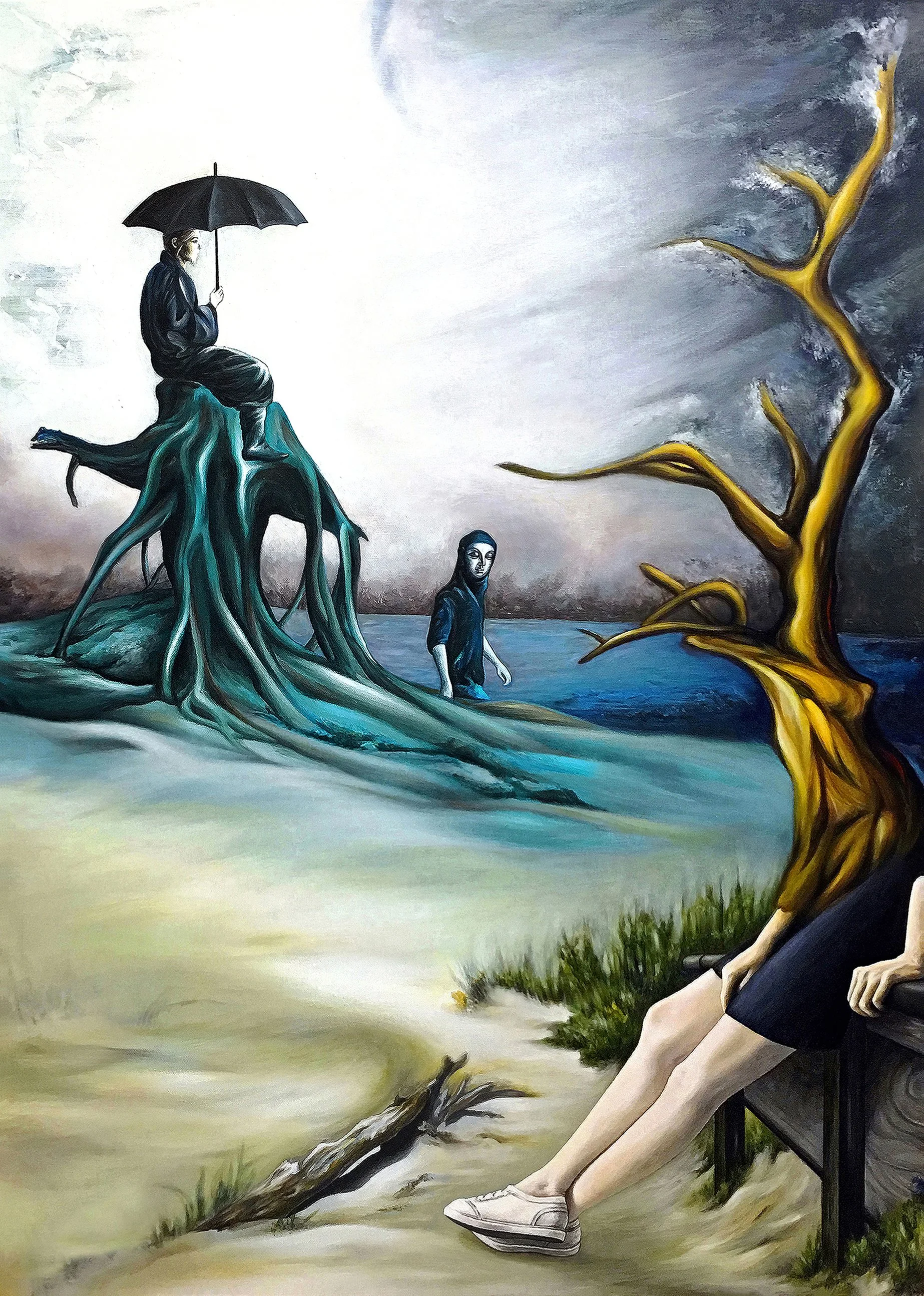
Eternal Moment. 2015. Acrylic on Canvas. 92 X 66 cm

The Condition of Life. 2021. Acrylic on Canvas. 53 X 73 cm
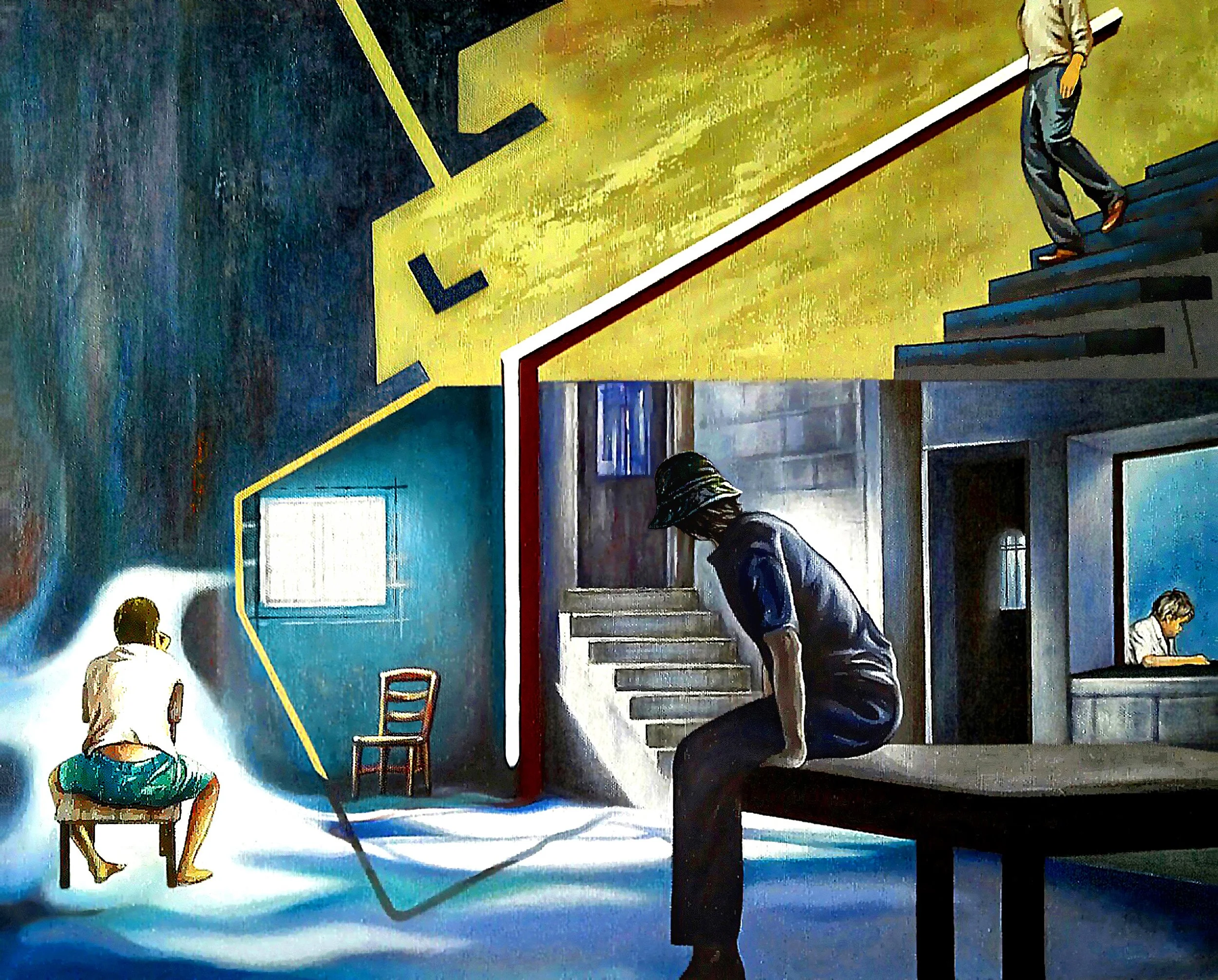
The Sound Hears The Sound. 2015. Acrylic on Canvas. 53 X 66 cm

The Thorns of Oblivion. 2021. Acrylic on Canvas. 53 X 73 cm

Everywhere But Nowhere. 2023. Acrylic on Canvas. 53 X 73 cm

River of The Plan. 2017. Acrylic on Canvas. 53 X 73 cm

The Whispering of Zero-Gravity. 2022. Oil and Acrylic on Canvas. 73 X 53 cm

The Spirit of the Fragrance. 2021. Acrylic on Canvas. 53 X 73 cm